By Shahzad Asghar · Head of Data and Digital Solutions, UN-ESCWA
The Last-Mile
AI Framework
A Practitioner's Guide from 20+ Years in Humanitarian Technology
Download the one-page framework (PDF)700K+
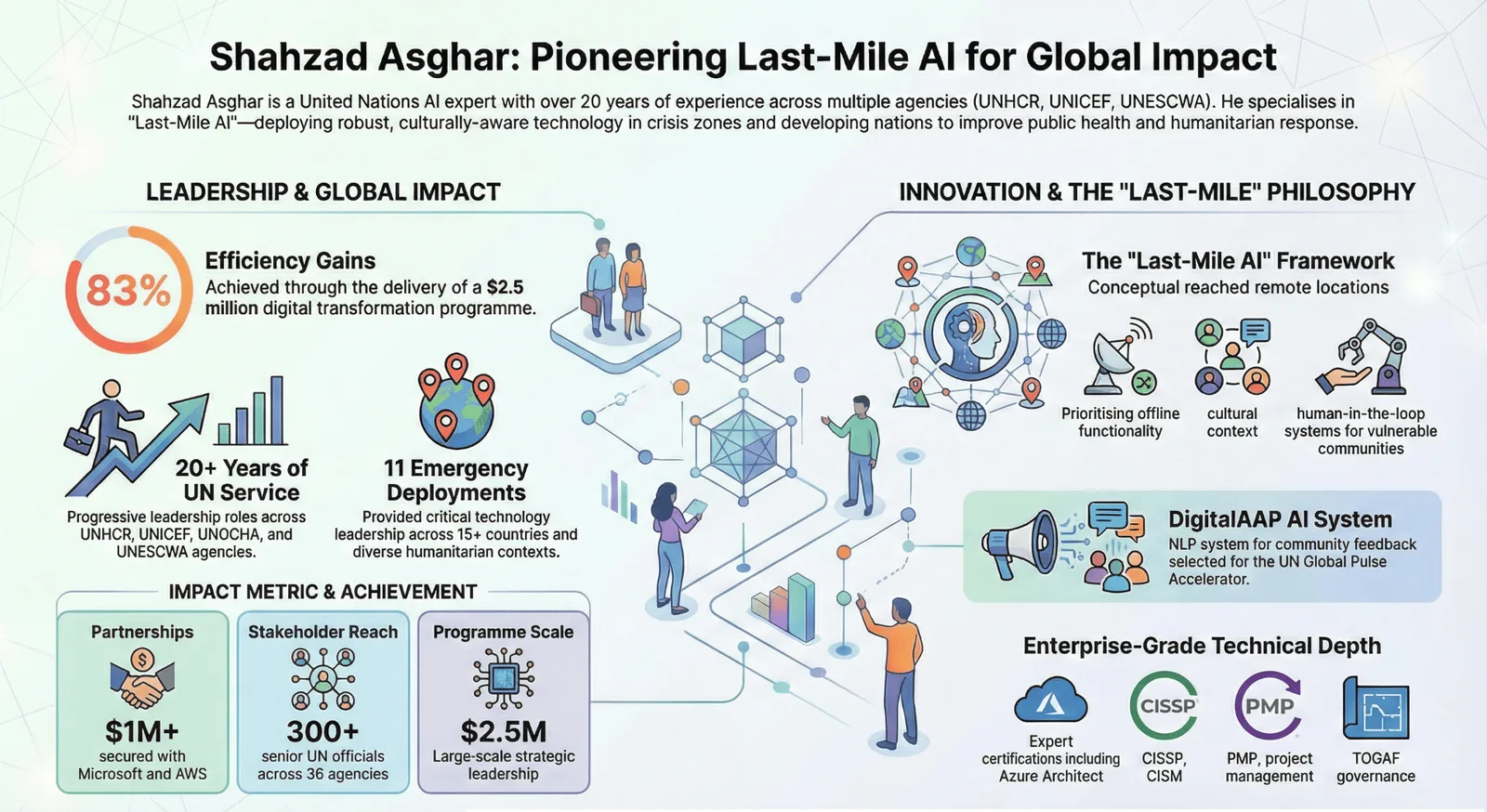
Refugees Served
20+
Years Experience
15+
Countries
11
Emergency Deployments
Shahzad Asghar
UNESCWA · Former UNHCR · UNICEF · UNOCHA
The Uncomfortable Truth
Here's something most AI guides won't tell you: 95% of AI frameworks were designed for organizations with perfect data, unlimited bandwidth, and engineers on speed-dial. That's not the world I work in. And if you're reading this, it's probably not yours either.
I've spent 20 years implementing technology in places where the power cuts out mid-deployment, where internet connectivity is a luxury, and where the people who need AI the most have never heard of ChatGPT. I've watched brilliant $2 million AI projects fail in the field because they were built for San Francisco, not South Sudan.
This framework was born from those failures. Every principle in here was tested in refugee camps, crisis response centers, and under-resourced government offices — not in a lab. It's the playbook I wish someone had given me on day one.
Who This Is For
- UN agencies and international organizations exploring AI adoption
- NGOs and humanitarian organizations with limited tech budgets
- Government digital transformation teams in developing countries
Overview
The 5 Pillars
Most frameworks give you a linear path: collect data, build model, deploy. That works in tech companies. In the real world — especially in humanitarian and development settings — you need a different architecture. One that assumes things will break.
Context Before Code
Understand the operational reality — connectivity, literacy, cultural context — before writing a single line of code.
Design for Failure
Build systems that work when the internet drops, when power fails, when the user has never touched a smartphone.
Human Loop, Always
AI assists decisions. Humans make them. Especially when those decisions affect refugees, patients, or vulnerable populations.
Local Ownership First
If local teams can't maintain it after you leave, you didn't build a solution — you built a dependency.
Measure What Matters
Not model accuracy. Not F1 scores. Did a refugee get help faster? Did a caseworker save time? That's your metric.
Deep Dive
The Framework in Action
Each pillar comes with a concrete question you must answer before moving forward. I've seen teams skip these questions and waste months. Don't.
Context Before Code
"Can a caseworker in a refugee camp use this with 2G internet and a cracked phone screen?"
Before you touch a dataset, spend a week — a real week — with the people who'll use your system. I learned this the hard way. In 2018, we built a beautiful data dashboard for UNHCR field offices. Elegant visualizations, real-time updates, responsive design. Nobody used it. Why? Field officers had 3-inch phone screens and intermittent 2G. They needed three numbers on a text message, not a dashboard.
- →Map connectivity reality (not what IT says — what actually works)
- →Identify the lowest-tech user in your chain — design for them
- →Document language, literacy, and cultural factors before starting
Design for Failure
"What happens when everything goes wrong at the same time?"
In Silicon Valley, 99.9% uptime is table stakes. In South Sudan, 60% uptime is a miracle. Your AI system needs to gracefully degrade, not crash. Our IVR system serving 700,000+ refugees was designed with offline-first architecture. When the server lost connectivity — which happened weekly — the system cached locally and synced when the connection returned. No data lost. No refugee left waiting.
- →Build offline-first: every function must work without internet
- →Create manual fallback procedures for every automated process
- →Test in the worst conditions, not the best — deploy at peak load times
Human Loop, Always
"Would I let this AI make this decision about my own family?"
AI helped us flag refugee resettlement cases that might need priority processing. It could analyze patterns across thousands of files faster than any human. But it never — never — made the final call. Because behind every data point is a family. A mother. A child who's walked 400 kilometers. No algorithm earns the right to decide their future. The human caseworker always had the final word.
- →Define exactly which decisions AI recommends vs. which humans make
- →Build override mechanisms that are easy to use, not buried in menus
- →Audit AI recommendations monthly for bias — especially in vulnerable populations
Local Ownership First
"If I leave tomorrow, will this still work in six months?"
The graveyard of international development is full of brilliant systems that died when the consultant left. I've seen it happen to $5 million projects. Every AI system I build, I train at least three local staff members to maintain it. Not "trained" as in a two-hour workshop — trained as in they can troubleshoot at 2 AM when something breaks. Because something will break. And I won't be there.
- →Train 3+ local team members to full system administration level
- →Document everything in plain language — not technical jargon
- →Use technology the local market supports (don't build on tools they can't buy)
Measure What Matters
"Did a real human being's life get measurably better?"
Our DigitalAAP system — selected for the UN Global Pulse Accelerator — used AI to analyze community feedback from refugees. We could have measured model accuracy. Instead, we measured: how many days faster did refugees get a response? Answer: 73% faster. How many issues were identified that humans missed? Answer: 340 in the first quarter. Those are the numbers that matter. Not your F1 score.
- →Define 3 human-impact metrics before building anything
- →Track time-to-benefit: how fast does AI help reach the end user?
- →Report results in human stories, not technical metrics — to maintain funding and support
Case Studies
Proof It Works
Frameworks are worthless without results. Here are three projects where these five pillars were applied — and what happened.
DigitalAAP — AI-Powered Refugee Feedback Analysis
UNHCR Jordan
Selected for UN Global Pulse Accelerator
Refugees across Jordan submit thousands of feedback messages monthly through hotlines, SMS, and community centers. Previously, caseworkers manually read every message. We built an AI system using NLP to automatically categorize, prioritize, and route feedback — flagging urgent protection concerns in real-time.
73%
Faster response to refugee concerns
340+
Hidden issues identified in first quarter
12K+
Monthly messages processed automatically
IVR Helpline — Voice AI for 700,000+ Refugees
UNHCR Jordan
Offline-First Architecture
Most refugees don't have smartphones or reliable internet. We built an Interactive Voice Response system in Arabic and other languages that works on any phone — even a $5 feature phone. The system uses voice recognition to route callers to the right service, provides automated updates on case status, and escalates urgent cases to human operators.
700K+
Refugees with access to services
24/7
Availability with offline fallback
83%
Reduction in call center wait times
$2.5M Digital Transformation Program
UNHCR Jordan
12-Person Team · Multi-Year Program
Led the design and implementation of a comprehensive digital transformation program that modernized data management, case processing, and inter-agency coordination systems. Applied all five framework pillars: built for the local context, designed offline fallbacks, kept humans in every decision loop, trained local staff to full ownership, and measured only what mattered to refugee outcomes.
83%
Operational efficiency gains
$2.5M
Program delivered on time and budget
3 yrs
Systems still running after project end
Annex
Visual Overview
"The AI revolution won't mean anything if it only reaches people who already have everything."
— Shahzad Asghar
Ready to Bring AI to Your Last Mile?
I help UN agencies, NGOs, and governments implement AI that actually works in the field.
Where this framework applies
- Last-Mile AIwhat the term means, and the constraints behind it
- Humanitarian AIaid operations
- AI governance in the UNinstitutional practice
- AI security and assurancecontrols and evidence
- Sovereign AInational capability
- Refugee operationsdelivered systems
- AI career guidance in Peruthe connectivity line, in the field
- About the authorbackground and credentials
shahzadasghar.com | © 2025 Shahzad Asghar