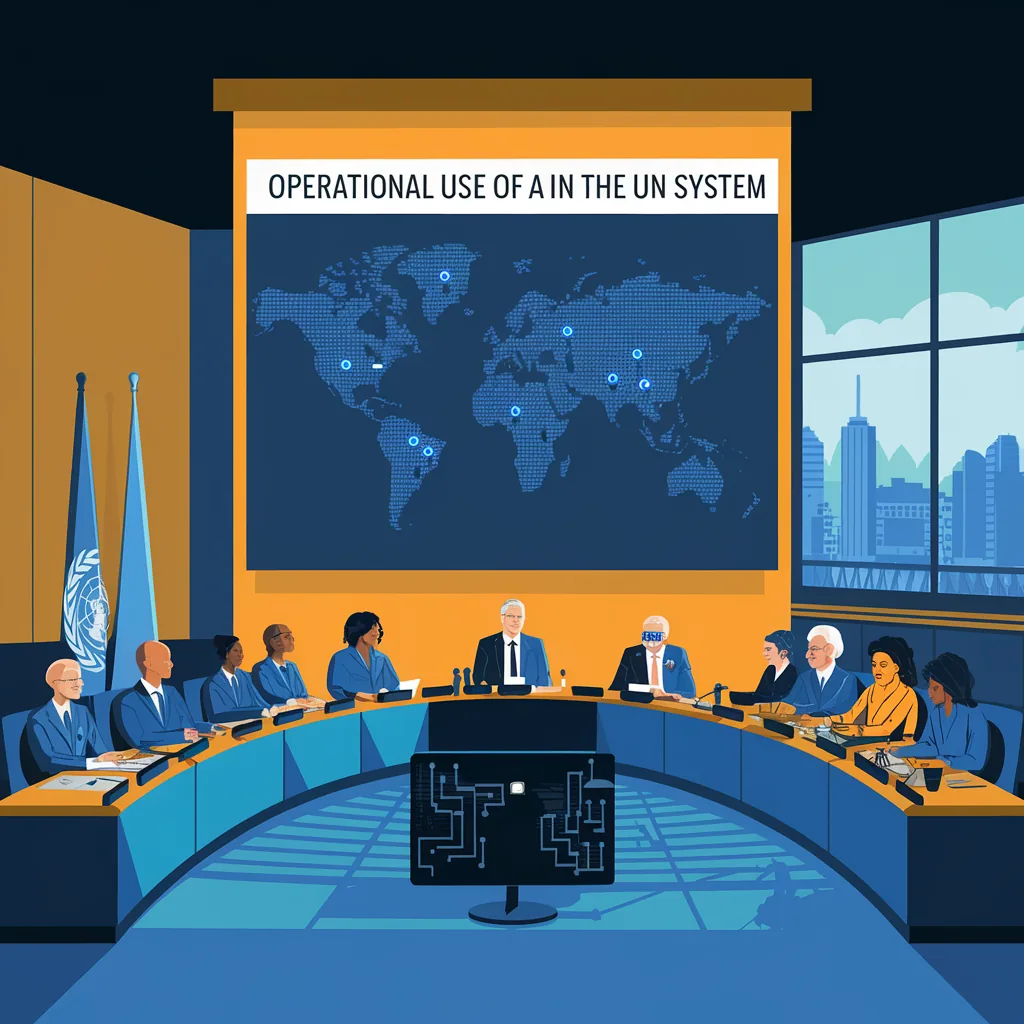
Operational Use of AI in the UN System
The United Nations system runs more than 700 AI projects across over 50 UN entities, but adoption is decentralized and inefficient, so it needs a unified, integrated, and coherent approach. About 64 percent of projects target custom thematic solutions, text and language processing dominates at 48 percent, and generative AI chatbots using retrieval-augmented generation are expanding fastest.
Published 2025-01-10 · By Shahzad Asghar
Briefing Document: Operational Use of AI in the UN System
1. Introduction & Context
This document summarises the key findings and recommendations from the "Report on the Operational Use of AI in the UN System". The report examines the increasing adoption of Artificial Intelligence (AI) across various UN agencies, highlighting both the opportunities and challenges presented by this technological shift. The overarching aim is to foster a more coordinated, efficient, and impactful use of AI to support the UN's Sustainable Development Goals (SDGs) and broader mandates.
Key Quote: "As AI adoption accelerates within the UN System, a growing number of agencies are leveraging these technologies to enhance their work and support their efforts towards achieving sustainable development."
2. Main Themes and Findings
The report is structured around five main focus areas:
Focus Area #1: AI Activities and Initiatives
This section provides an overview of the AI projects and activities across the UN system. It emphasizes the decentralized nature of AI adoption, leading to both innovation and potential duplication of effort. It notes the importance of collaborative efforts like the High-Level Committee on Management (HLCM) Digital and Technology Network (DTN), the High-Level Committee on Programmes (HLCP) Inter-Agency Working Group on AI (IAWG-AI), the UN Innovation Network (UNIN), and the ITU AI for Good Platform.
Key Finding: There are over 700 AI projects across 50+ UN entities. These are classified by level of detail and applicability (conceptual, practical, or both), and by target audience and scope (internal, external, or both).
Focus Area #2: AI Use Cases and Solutions
This section explores the application of AI across the UN System. It categorises projects by data type (text, mixed/multimodal, quantitative, GIS/geospatial, audio, image/video) and notes the prevalence of custom solutions for thematic work. The PRISM framework, developed by the DTN GenAI CoP, is introduced as a tool for prioritizing AI use cases.
Key Finding: Most projects are focused on custom thematic solutions (64%), with text, documents and language being the most used data type (48%).
Focus Area #3: AI Project Platforms
The report addresses the need for open-source practices and collaborative platforms. It highlights the UN's presence on platforms like GitHub and Hugging Face and details efforts to establish a UN-wide open-source ecosystem, led by the DTN Open-Source Software Community of Practice (DTN OSS CoP). The Development Data Partnership is presented as an example of a successful collaborative project platform.
Key Finding: There is a strong UN presence in open-source platforms, especially Github, and efforts are underway to formalize a UN open-source approach.
Focus Area #4: Emergence of Generative AI
This section examines the impact of generative AI, particularly the use of Large Language Models (LLMs) and chatbots. It describes projects that are in pilot or experimental stages. It emphasises the importance of Retrieval Augmented Generation (RAG) techniques. The case study of ITCILO’s AnswerMate is examined as an example of successful implementation.
Key Finding: Generative AI, specifically chatbots using RAG techniques, are being rapidly adopted.
Focus Area #5: Adopting and Adapting to AI
This section delves into the organisational aspects of AI integration, focusing on governance, strategy, and structure. It notes various approaches across different agencies - from top-down strategies to bottom-up initiatives. The section presents a look at the challenges and opportunities from organisational approaches within organisations such as FAO, IFAD, IMF, UNDP, UNHCR, UNJSPF, UNICEF, and WFP.
Key Finding: UN agencies are experimenting with approaches to implementing AI, some more centrally structured than others. The approach is dependent on the organisation's individual needs.
3. Key Ideas and Facts
Decentralization & Collaboration: While AI adoption is accelerating across the UN, the decentralized nature of the system presents challenges, potentially leading to duplicated effort and missed opportunities.
"The decentralized nature of the UN System presents challenges in the context of AI adoption, development, and integration. While individual agencies have made significant strides in implementing AI solutions tailored to their specific needs, there is a risk of duplicating efforts and resources..."
Interdisciplinary Approach: Many UN challenges require interdisciplinary approaches, which can benefit from collaborative AI development between agencies.
"...the complex and multifaceted challenges addressed by the UN may require interdisciplinary approaches that could benefit from collaborative inter-agency development on AI."
Importance of Frameworks: The report highlights the importance of tools and frameworks to make informed decisions about AI projects.
- PRISM Framework: A framework designed for UN organisations to evaluate AI projects and assist in making informed decisions.
- WIPO Risk Assessment Framework: A tool designed to evaluate the risks associated with commercial AI products.
Open Source: The UN recognises the value of open-source practices for the responsible development of software, including the need for security, privacy, and data protection. A focus is on establishing a secure, open-source ecosystem within the UN.
“Open-source practices are essential to modern software development, with several open-source technologies, projects, and communities having shaped the way of working for all technology professionals, regardless of background or domain.”
Generative AI & RAG: Generative AI technologies, particularly chatbots using RAG (Retrieval Augmented Generation), are increasingly used for knowledge management and improving access to information.
"In the context of Generative AI chatbots and similar applications, retrieval-augmented generation (RAG) is fast becoming one of the most widely adopted and implemented techniques in projects across the UN System."
Data Divide: The report notes the disproportionate amount of English-language datasets and models on platforms such as Hugging Face, underscoring the need to address digital inclusion.
4. Recommendations
The report makes several recommendations focused on achieving strategic and cohesive adoption of AI across the UN system:
General Recommendation: Develop a unified, integrated, and coherent approach to AI technologies and implementation.
Specific Recommendations:
- Create a normative guidance/model policy for the use of AI within the UN System.
- Promote mechanisms for pooling technical capacity and knowledge sharing.
- Centralise and standardise cataloging efforts of AI activities, initiatives, use cases and solutions.
- Continue knowledge sharing in AI communities of practice, supporting their activities with sufficient resources.
- Encourage the use of the PRISM framework for evaluating and prioritizing AI use cases.
- Support the development of a project-hosting platform for the UN System and promote responsible open-source practices.
- Develop a risk assessment framework for AI use in the UN System, providing guidance on common risks and mitigations.
- Strengthen and leverage collective bargaining agreements with AI technology vendors.
- Explore partnerships with public and private entities to mobilise resources for AI development.
- Conduct targeted assessments and develop business cases for UN system-wide AI assets.
- Actively engage in wider AI-adjacent platforms to continue investment in AI growth.
- Consider recommendations regarding AI governance contained in the United Nations System White Paper on AI Governance.
- Extend the scope of existing communities and working groups to cover the AI domain holistically.
- Actively contribute to the development of AI-related components for system-wide use (code, datasets, models).
5. Conclusion
The report provides a comprehensive overview of AI adoption within the UN, highlighting both the potential and the challenges. The key message is that a more collaborative, coordinated, and strategic approach is needed to fully realize the benefits of AI while ensuring ethical and responsible implementation across the UN system. The report emphasizes the need for unified frameworks, shared resources, and a focus on responsible AI development and deployment.
Written by Shahzad Asghar — Head of Data and Digital Solutions at UN-ESCWA, with 20+ years building AI and data systems across UNHCR, UNICEF, and UNOCHA. His team built UNHCR’s first global IVR appointment system, serving 700,000+ refugees. He created the Last-Mile AI Framework. Read more about this UN AI expert