· Shahzad Asghar
What Comes After Agentic AI? The Concepts Defining 2027
For two years every conference deck has had an agent on it. Then, on 20 October 2026, Gartner published its top strategic technology trends for 2027 at its IT Symposium in Orlando, and the phrase agentic AI was not on the list.
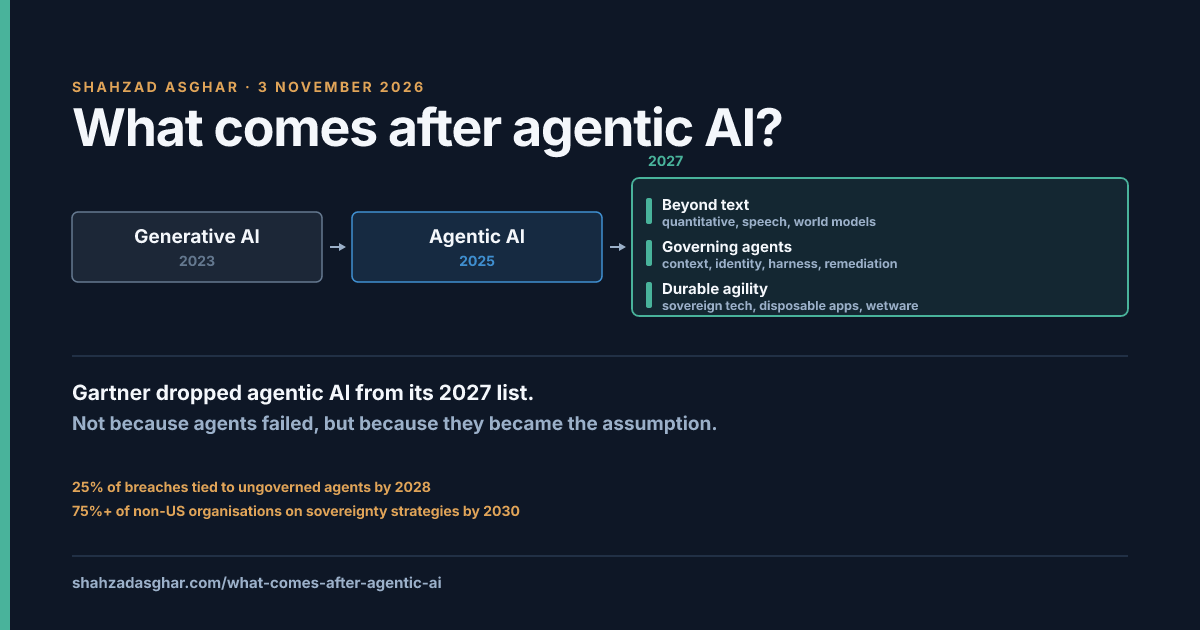
Agents have not failed. They have become the assumption underneath everything else, and the conversation has moved to what they need around them to work safely and at scale.
This article answers the question I now hear in most strategy meetings: what comes after agentic AI? It covers the ten concepts Gartner ranks for 2027, what Nvidia and the research community call the next wave, and which of these terms a public sector digital leader should actually put into a 2027 strategy.
Why agentic AI stopped being the headline
Agentic AI was Gartner’s number one strategic technology trend for 2025. Less than two years later it does not appear on the 2027 list at all. That is not a verdict on agents. It is a sign that the market has stopped asking whether agents work and started asking what they need around them.
Gartner’s own research explains the shift. Its Hype Cycle for Agentic AI, published in April 2026, says progress is rapid but still exceeded by hype and confusion. Its Hype Cycle for Artificial Intelligence, published in August 2026, notes that investment remains strong while value realisation is uneven.
Presenting the 2027 trends, Gartner analyst Gene Alvarez described the problem in three parts. AI now generates software faster than people can review it. It creates credential paths that nobody manages. And it ties business processes to single vendors. His conclusion was that organisations have to stop observing what models can do and start designing the boundaries between the organisation, its people and its machines. (Gartner press release, 20 October 2026)
That is the lens for everything that follows. Most of what comes after agentic AI is scaffolding for agents, not a replacement for them.
The new vocabulary: Gartner’s ten strategic technology trends for 2027
Gartner groups the 2027 trends under three themes: leverage the non-textual AI frontier, govern the autonomous agent platform, and architect durable agility. Here is each trend in plain language, with the prediction Gartner attached to it. (Gartner Top 10 Strategic Technology Trends for 2027)
Beyond text: the non-textual AI frontier
- Large quantitative models (LQMs). Models built for mathematics, physics and time-series forecasting rather than for predicting the next word. Gartner’s argument is that a language model doing numerical work is guessing, and that guessing creates accuracy and compliance risk. Language models become the interface for asking the question; the LQM does the calculation.
- Speech reasoning models. Voice AI that understands tone and context, not only words. The standard example is a contact centre model that hears frustration and escalates the call to a person. Gartner flags a privacy cost: voice patterns are identifiable data and belong in your privacy notice.
- World models. Physics-aware models that let machines and agents simulate an outcome before acting on it. Gartner expects organisations to run 3D spatial simulations of business scenarios by 2031. These models are compute hungry, and Gartner suggests piloting them on events that already happened to test their predictions.
Governing the autonomous agent platform
- AI context platforms. Systems that scan an organisation’s data, policies and documents so agents act within that organisation’s real context rather than a generic one. Alvarez compared the context layer to a new employee who learns how the business works over time. Interoperability is the first thing to evaluate.
- Agent coding harness. A closed-loop control system that manages the whole software development lifecycle, so developers are not manually verifying every line of AI-written code. Gartner’s advice is to keep developers leading it, because the harness learns from their knowledge and improves as an asset.
- AI agent identity. Identity and access controls for agents, replacing static credentials with dynamic, policy-controlled access. Gartner forecasts that 25% of enterprise security breaches will trace back to ungoverned AI agents by 2028.
- Autonomous exposure remediation. AI that scans, patches and tests vulnerabilities on its own, embedded in the coding harness so that security keeps pace with machine-speed code generation.
Architecting durable agility
- Sovereign tech. Control over hardware, software, data and models, with an exit strategy from every vendor. Gartner predicts that more than 75% of organisations outside the United States will adopt digital sovereignty strategies by 2030 to limit vendor lock-in and geopolitical risk.
- Disposable applications. Applications built for one need, with an expiry date, decommissioned as soon as they stop returning value. The governance shift is to manage every application from creation to retirement, including software bought off the shelf.
- Wetware as a service. AI computing on living or synthetic biological neurons, pitched on energy efficiency against the 20 watts a human brain runs on. It is at pilot stage, years from use, and raises ethical questions about substrate donation and ownership.
What the wider industry says comes next
Gartner is not the only voice. Three other answers to what comes after agentic AI are worth knowing, because they shape vendor roadmaps and research funding.
Physical AI
Nvidia’s position, set out ahead of its GTC event in Washington, is that the next wave is AI that perceives the physical world, reasons about its environment and acts through robots, vehicles and devices. Gartner has followed with a separate Hype Cycle for Physical AI covering 22 technologies across embodied robotics, autonomous mobility, teleoperation and intelligent infrastructure. World models are the bridge between physical AI and the 2027 list. (Network World on the 2027 trends)
Multi-agent systems and governed autonomy
A growing body of practitioner writing frames the post-agentic phase as many agents collaborating across tasks under defined policies, safety rails and auditability. The emphasis is on discipline rather than new capability, which lines up with Gartner’s identity and context trends.
The agentic web
The more speculative idea is an internet designed for agent-to-agent interaction, with orchestration layers that assign specialised agents to parts of a problem. This is still closer to a blog post than a product. It does explain why agent identity and context platforms are urgent now: an agent that transacts with other agents needs a verified identity and a reliable picture of the organisation it represents.
What this means for UN and public sector digital leaders
Most of this list lands on a public sector CIO as governance work, not procurement. Three of the ten terms will reach you first, usually through an audit question or a contract renewal.
- AI context platform. Agent pilots in large organisations tend to fail on the same thing: the agent does not know your policies, your data classifications or how your business actually runs. A context platform is where that knowledge lives. Treat it as a data governance asset with a named owner, not as a vendor feature.
- AI agent identity. Auditors will start asking which non-human identities exist, what they can access and who approved them. If agents run on shared service accounts today, that is the first finding waiting to happen. See ISO/IEC 27090 explained for the standard that covers security threats to AI systems.
- Sovereign tech. For organisations operating across many jurisdictions, under donor and host government scrutiny, Gartner’s 75% forecast reads less like a prediction and more like a description. Exit clauses, data residency and model portability belong in every AI contract signed from now on.
The harness and remediation trends matter most to the teams building agents in house. If you want to see how a harness controls an agent loop, tool calls, permissions and guardrails, the interactive harness explainer on this site walks through a support-agent run step by step.
The non-textual trends are longer-term bets. Large quantitative models are the one to watch for anyone whose decisions rest on numbers: caseloads, supply forecasts, budget projections. A model built for quantities is a different proposition from a chatbot that reads a spreadsheet, and the difference will show up in audit trails. The AI concepts explainer covers the underlying ideas in plain English.
FAQ
Is agentic AI over?
No. It has become the default assumption. Gartner dropped it from the 2027 list because the open questions are now about context, identity, security and sovereignty around agents, not about whether agents work.
What are large quantitative models?
Models built for numerical, time-series and physics-based reasoning rather than for text. Gartner lists them first among its 2027 trends and expects language models to become the interface for prompting them.
Why does Gartner link AI agents to security breaches?
Because agents usually run on static credentials and inherit broad privileges. Gartner forecasts that 25% of enterprise breaches will trace back to ungoverned agents by 2028, and proposes dynamic, policy-controlled identity for every agent.
What is the difference between agentic AI and physical AI?
Agentic AI acts in software: it plans, calls tools and completes digital tasks. Physical AI perceives and acts in the physical world through robots, vehicles and devices, usually with a world model underneath.
Which of these concepts should a CIO act on in 2027?
AI context platforms, AI agent identity and sovereign tech. The rest are either engineering concerns for the teams building agents or multi-year bets that can wait for a pilot.
The short version
What comes after agentic AI is not a new kind of agent. It is the infrastructure that makes agents trustworthy: context, identity, harnesses and security, plus a push beyond text into numbers, voice and the physical world.
The organisations that treat 2027 as a governance year rather than a pilot year will be the ones still running agents in 2028.
If you are updating an AI strategy or governance framework for 2027 and want these ten concepts mapped against your own maturity, start with the Last-Mile AI Framework or get in touch.
Sources
- Gartner Identifies the Top Strategic Technology Trends for 2027 (press release, 20 October 2026)
- Gartner Top 10 Strategic Technology Trends for 2027 (overview and themes)
- Gartner unveils top technology trends at Gartner IT Symposium (TechTarget)
- Gartner’s top tech trends for 2027 expand and constrain AI capabilities (Network World)
- Gartner Hype Cycle for Agentic AI (April 2026), Hype Cycle for Artificial Intelligence (August 2026) and Hype Cycle for Physical AI Industry Applications (September 2026), cited by title; these are subscriber documents.