Free downloads · Excel · Word · PDF · CC BY 4.0

ISO/IEC 27090 templates: free AI security downloads

Seven free templates for implementing ISO/IEC 27090:2026, the international standard on security threats to AI systems. An AI system inventory register, a threat and risk assessment workbook, a control mapping and gap analysis against ISO/IEC 27002:2022, an AI security policy with a responsibility matrix, and an implementation pack with an owner nomination form, a workshop agenda and a purchase request. Each is editable in Excel or Word and previewable as PDF, licensed CC BY 4.0 by Shahzad Asghar.

By Shahzad Asghar, CISSP, CISM · Written in a personal capacity · Reviewed

The four templates taught in the course

Lesson 10 of the course walks through these four documents in order: list the systems, assess each one against the twelve threats, record the control gaps, and adopt a policy that names who is responsible. Each Excel file contains drop-downs, scoring formulas and a summary that update as you type; each Word file uses blue italic placeholders you replace. The PDF is a read-only preview of the same file.

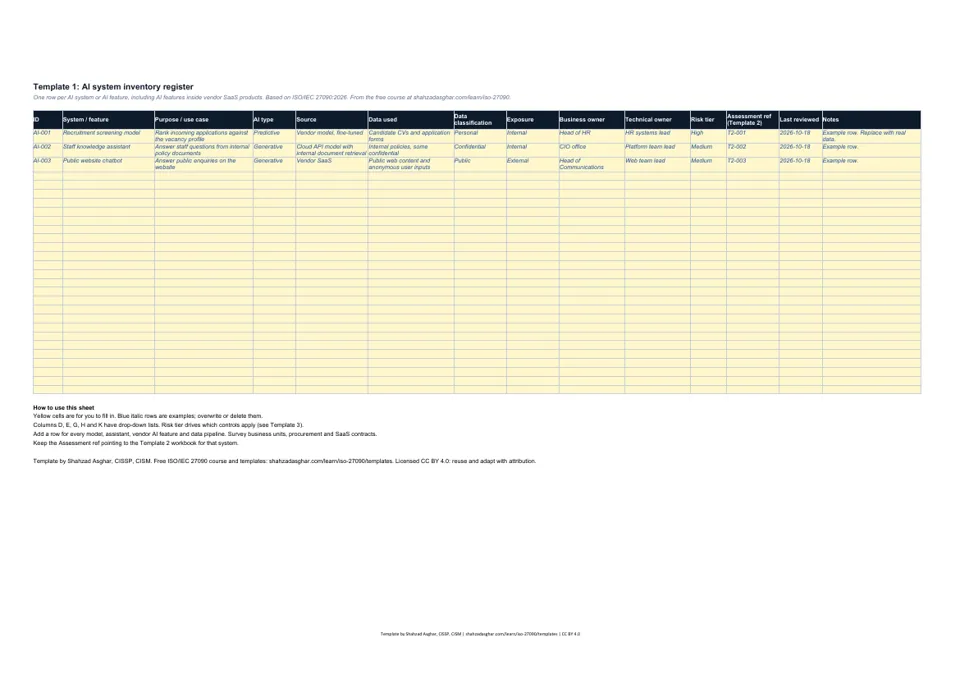
First page of the ISO/IEC 27090 AI system inventory register template showing the column headers and example rows

Template 1

AI system inventory register (Excel)

One row per AI system or AI feature, including AI inside vendor software and shadow AI found through expense and network records. The register is the starting point for everything else in the standard: a threat assessment cannot be run on a system nobody has listed.

What is in the file

  • Fourteen columns: ID, system, purpose, AI type, source, data used, data classification, exposure, business owner, technical owner, risk tier, assessment reference, last reviewed, notes
  • Drop-downs for AI type, source, classification, exposure and risk tier
  • Three example rows in blue italics to overwrite, and a legend explaining each column
  • Summary sheet that counts systems by risk tier, external exposure, generative AI and personal data, updating as rows are added

How to use it

  • List every model, assistant, vendor AI feature and data pipeline, including those in purchased software
  • Apply the tier rule: High for personal or confidential data, external exposure or decisions about people or money; Medium for internal use with confidential data; Low for public data and no decisions
  • Name a business owner and a technical owner for each row before its assessment starts

Taught in lesson 10: Implementing ISO/IEC 27090 in your organization
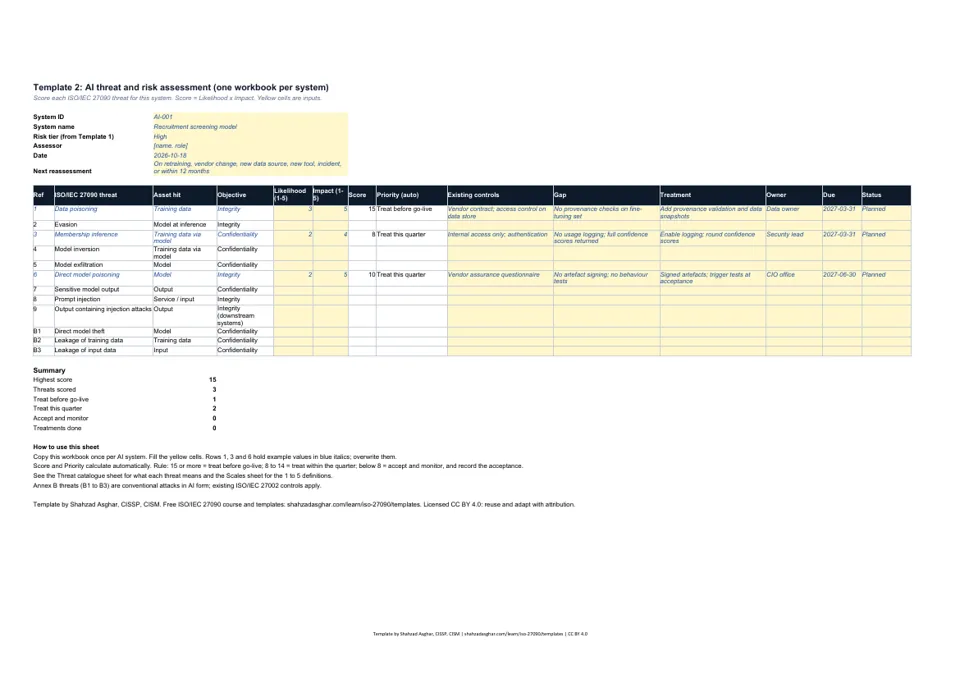
First page of the ISO/IEC 27090 AI threat and risk assessment workbook with one scored row per threat

Template 2

AI threat and risk assessment workbook (Excel)

One workbook per AI system. Each of the twelve threats in ISO/IEC 27090 has a row scored for that system, with likelihood, impact, existing controls, gap and treatment. Scores and priorities calculate automatically, and a summary records the residual risk statement.

What is in the file

  • Assessment sheet with one row per catalogue threat: nine threats from clause 6 and the AI versions of conventional attacks from Annex B
  • Likelihood and impact scales on a Scales sheet, with the scoring method the workshop agrees
  • Score and priority formulas: score equals likelihood times impact; High at 15 or more, Medium at 8 or more
  • Threat catalogue sheet: for each threat the asset hit, the objective, where it sits in the standard, what it is, consequences, detection and mitigation

How to use it

  • Copy the workbook once per system and record the system ID from Template 1 at the top
  • Score each threat in a workshop with the business, technical and data owners present
  • Assign an owner and due date to every treatment and carry the gaps into Template 3

Taught in lesson 5: The threat catalogue: how ISO/IEC 27090 classifies threats

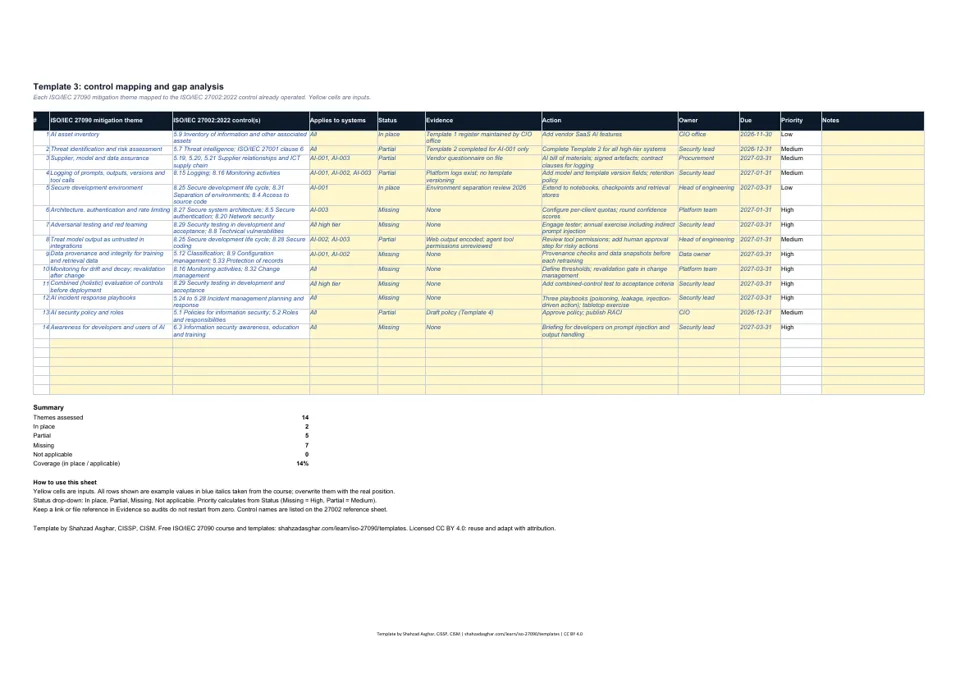
First page of the ISO/IEC 27090 control mapping and gap analysis template against ISO/IEC 27002:2022

Template 3

Control mapping and gap analysis against ISO/IEC 27002:2022 (Excel)

Maps each ISO/IEC 27090 mitigation theme to the ISO/IEC 27002:2022 controls that carry it, records status, evidence, action and owner, and calculates coverage. Most controls already exist in an ISO/IEC 27001 programme and only need wider scope; this sheet shows which ones.

What is in the file

  • Gap analysis sheet: theme, ISO/IEC 27002 control, systems in scope, status, evidence, action, owner, due date and priority
  • Status drop-down: In place, Partial, Missing, Not applicable; priority calculates from status
  • Coverage summary: controls in place, partial and missing as counts and as a percentage
  • Reference sheet listing every ISO/IEC 27002:2022 control named in the mapping

How to use it

  • Work through the rows after the first threat assessments, marking status from evidence rather than from memory
  • Keep a link or file reference in the Evidence column so audits do not restart from zero
  • Review the coverage percentage at each steering meeting of the six-month roadmap

Taught in lesson 9: Mitigations and how controls interact (Clause 7)

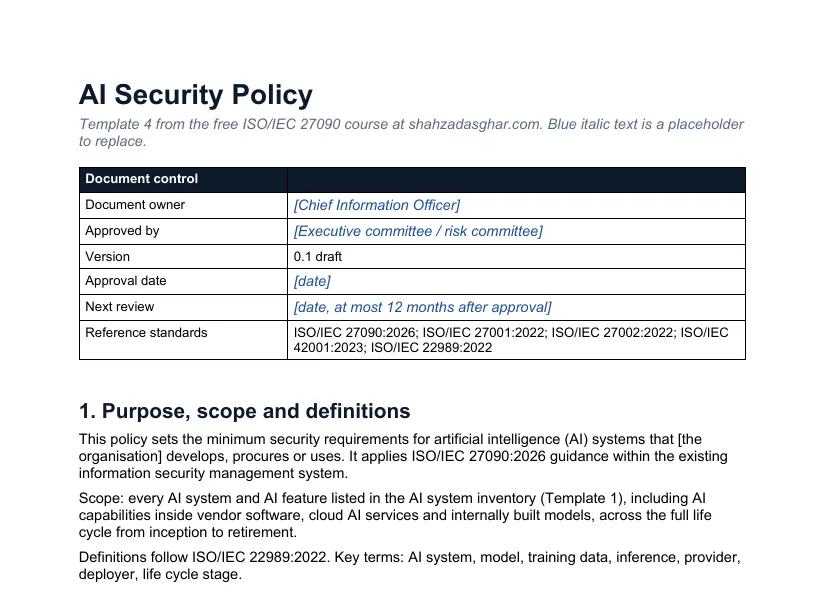
First page of the ISO/IEC 27090 AI security policy template with document control block and purpose section

Template 4

AI security policy with responsibility matrix (Word)

A short policy that sets the minimum security requirements for AI systems the organisation develops, procures or uses, written to sit inside an existing ISO/IEC 27001 information security management system. The responsibility matrix names who is accountable, responsible, consulted and informed for each duty.

What is in the file

  • Document control block and nine sections: purpose and scope, roles, inventory and tiering, threat and risk assessment, secure development and supply chain, deployment and access control, logging and revalidation, incident response, testing and acceptance
  • Roles and responsibilities: Chief Information Officer, security lead, AI product owner, data owner, legal and privacy
  • Annex A: responsibility matrix (RACI) across the AI life cycle; Annex B: the related templates
  • Placeholders in blue italics for owner, approver and dates

How to use it

  • Replace the placeholders for owner, approver and review date, then route through the usual policy approval
  • Keep the policy short; the templates and the risk assessment carry the detail
  • Review annually or when a new class of AI system enters use

Taught in lesson 3: The AI life cycle and who is responsible

Implementation pack

Three short documents that get the first month moving: name an owner for every system, book the first threat assessment workshop, and buy the standard for the people who will implement it.

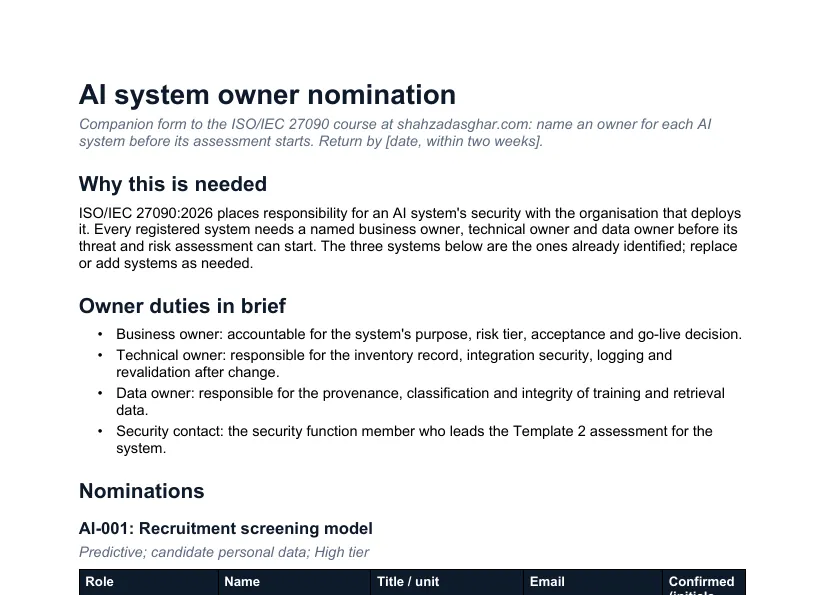
First page of the AI system owner nomination form

AI system owner nomination form (Word)

A one-page form that names a business owner, a technical owner, a data owner and a security contact for each AI system before its threat assessment starts. ISO/IEC 27090 places responsibility with the organisation that deploys the system; this form turns that principle into named people.

What is in the file

  • Why owners are needed and what each owner is responsible for
  • A nomination block per system with name, role, date and signature
  • Three example systems to replace with your own

How to use it

  • Send one copy to each business unit that runs AI systems, with a return date of two weeks

Taught in lesson 3: The AI life cycle and who is responsible

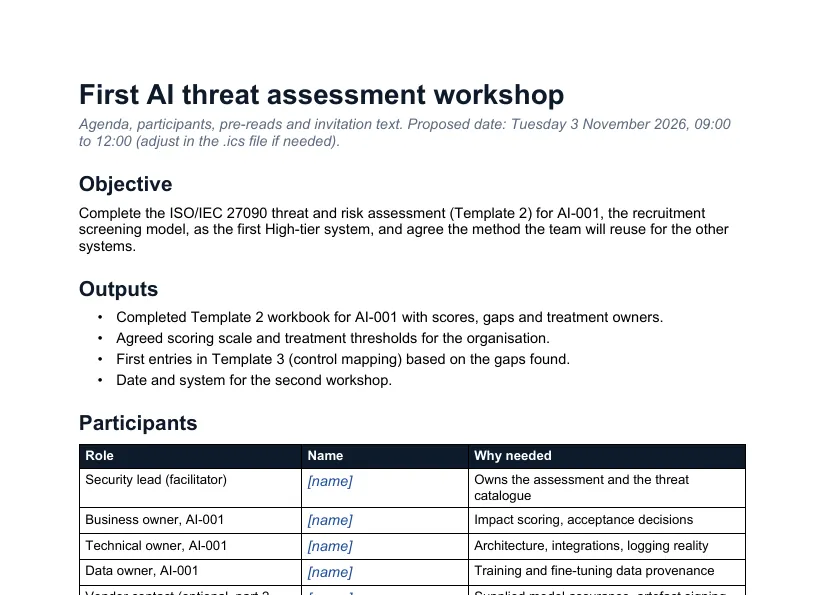
First page of the AI threat assessment workshop agenda

Threat assessment workshop agenda and calendar invite (Word and ics)

A three-hour agenda for the first AI threat assessment workshop: participants, pre-reads, a timed walk through the twelve threats, treatments and decisions. The calendar file carries the invitation text and a reminder; change the date, time and location before sending.

What is in the file

  • Participant list by role, with what each person brings
  • Pre-reads: the threat catalogue lessons and the Template 2 workbook
  • Timed agenda from purpose and scoring rules to residual risk statement
  • Invitation text and a calendar file with a one-day reminder

How to use it

  • Run the first workshop on the highest-tier system; it sets the scoring method the others reuse

Taught in lesson 5: The threat catalogue: how ISO/IEC 27090 classifies threats

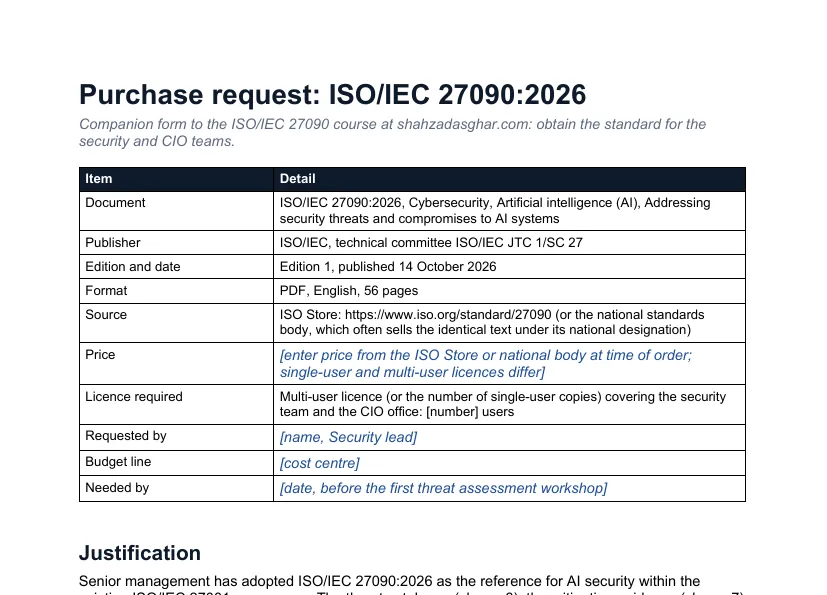
First page of the purchase request form for ISO/IEC 27090:2026

Purchase request for the standard (Word)

A filled-in purchase request for ISO/IEC 27090:2026, with publisher, edition, format, source, licence type, justification and the related standards to consider in the same order. The templates summarise the standard; the implementation team needs the text to verify clause wording and the annexes.

What is in the file

  • Order details table with placeholders for price, licence count, requester, budget line and date needed
  • Justification paragraph tied to the ISO/IEC 27001 programme
  • Related standards: ISO/IEC 27002:2022, ISO/IEC 42001:2023, ISO/IEC 22989:2022
  • Licence compliance notes and an approval block

How to use it

  • Check the current price and licence options on the ISO Store or your national standards body before submitting

Taught in lesson 4: Where ISO/IEC 27090 fits: standards, frameworks and regulation

Licence and attribution

Every file on this page is released under the Creative Commons Attribution 4.0 International licence. You may use, adapt and share them, including inside commercial organisations, as long as you keep the attribution line that appears in the footer of each file:

Shahzad Asghar, shahzadasghar.com/learn/iso-27090/templates, CC BY 4.0

The templates summarise ISO/IEC 27090:2026 and do not reproduce its text. ISO/IEC 27090 is copyrighted and is sold through the ISO Store and national standards bodies; the purchase request above is there to make buying it easy.

Use them in this order

  1. 01

    Register. Fill Template 1 with every AI system and AI feature, name owners with the nomination form, and set a risk tier for each.

  2. 02

    Assess. Book the workshop and complete Template 2 for each High-tier system first, then Medium.

  3. 03

    Close gaps. Carry the treatments into Template 3, attach evidence, and watch the coverage percentage rise.

  4. 04

    Govern. Adopt Template 4 through the normal policy route and review it annually or when a new class of AI enters use.

Frequently asked questions

Are the ISO/IEC 27090 templates free?
Yes. Every file on this page is free to download, use and adapt inside your organisation. They are licensed under Creative Commons Attribution 4.0, which asks only that you keep the attribution line to Shahzad Asghar and this page when you share or republish them.
Do I need to buy the standard to use the templates?
The templates work on their own, but an implementation team should buy ISO/IEC 27090:2026 from the ISO Store or a national standards body. The templates summarise the standard and do not reproduce its text; the purchased copy lets you verify clause wording, Annex A and Annex B before you finalise them.
Which template do I start with?
Template 1, the AI system inventory register. Nothing in the standard can be applied to a system that has not been listed. Once every AI system and AI feature has an owner and a risk tier, copy Template 2 once per high-tier system, then record the control gaps in Template 3 and adopt the policy in Template 4.
Why are there Excel, Word and PDF versions?
Excel and Word files are the editable working copies: the Excel workbooks contain drop-downs, scoring formulas and a summary that update as you type. The PDF versions are read-only previews for people who want to see the structure before downloading, or to share with reviewers who should not edit the file.
Do the templates map to ISO/IEC 27001 and 27002?
Yes. Template 2 extends an ISO/IEC 27001 risk assessment with AI assets and the twelve threats catalogued in ISO/IEC 27090. Template 3 maps each threat to the ISO/IEC 27002:2022 controls that address it, records status and evidence, and calculates coverage, so it doubles as the audit evidence package.
Can I use the templates with ISO/IEC 42001 or the NIST AI RMF?
Yes. The inventory and risk assessment feed the context and risk clauses of an ISO/IEC 42001 AI management system, and the same rows map onto the Map and Measure functions of the NIST AI Risk Management Framework. The templates are deliberately plain so they can be pasted into whichever system your organisation already runs.

Learn the standard first

The templates make most sense after the free course, which explains the twelve threats the assessment scores and the controls the gap analysis maps. Ten lessons, a quiz after each, and a certificate at the end.

Start the course
Shahzad Asghar

Shahzad Asghar, CISSP, CISM

More than twenty years building and securing data and AI systems in United Nations agencies. Holds the CISSP and CISM security certifications and writes here, in a personal capacity, on AI governance, AI security and assurance, and digital transformation. Connect on LinkedIn.

This course is an independent educational resource by Shahzad Asghar. It is not affiliated with, endorsed by or published by ISO or IEC. ISO/IEC 27090:2026 is copyrighted and is sold through the ISO Store and national standards bodies; this course summarises it and does not reproduce its text. Last reviewed: .